


If your game night usually involves the fast-paced fun of Uno or Exploding Kittens, you already know the power of a great card game. But maybe you’re looking for something with a little more adventure—a way to sling fireballs and battle monsters instead of just changing the color to red. You’ve probably seen Dungeons & Dragons in shows like Stranger Things, but the idea of thick rulebooks and all-day sessions can feel like a quest in itself. Check out Alternatif PANGLIMA88 to know more
This is where the dnd card game comes in. These games are designed to capture the thrilling theme of a fantasy adventure and pack it into a format you can learn in minutes. They brilliantly separate the exciting idea of D&D—playing a powerful hero, fighting cool monsters, and finding treasure—from the complex mechanics that can be so intimidating for newcomers. They are a ticket to the world of fantasy, no assembly required.
In practice, these quick tabletop games let you jump straight into the action. Forget about homework or memorization; you simply pick a character, like a cunning rogue or a mighty paladin, and your deck of cards gives you all the attacks, defenses, and special moves you need. A full match is often over in just 15 to 20 minutes, with a clear winner at the end—usually the last hero standing.
This guide cuts through the confusion by introducing the best family friendly fantasy card games available, starting with the easiest and most popular choice for your first adventure. By the end, you’ll feel confident picking the perfect game to bring a little heroic fantasy to your table.
What Makes a Card Game Feel Like Dungeons & Dragons?
To capture the spirit of a D&D adventure, these card games focus on a few key ingredients that set them apart from a standard pack of playing cards.
- You Play a Character: You might choose to be a mighty Barbarian whose cards are all about hitting hard, or a cunning Rogue who specializes in sneaky moves and quick escapes. Each character, or class, has their own deck that fits their unique playstyle.
- It’s Full of Fantasy Flavor: The cards are filled with classic D&D monsters, spells, and treasures. You’ll be slinging a “Magic Missile” or fighting a “Gelatinous Cube,” not just playing a “plus four.”
- The Goal is an Adventure: Victory isn’t about collecting sets or having the best poker hand. It’s usually a fun, chaotic brawl to be the last hero standing.
Together, these elements create a fast-paced fantasy battle in a box. It’s a game that gives you the thrill of casting spells and battling monsters without needing a rulebook the size of a dragon. You get all the flavor of a grand adventure, distilled into a game night experience anyone can enjoy.
Your First Adventure: Why Dungeon Mayhem is the Perfect Starting Point
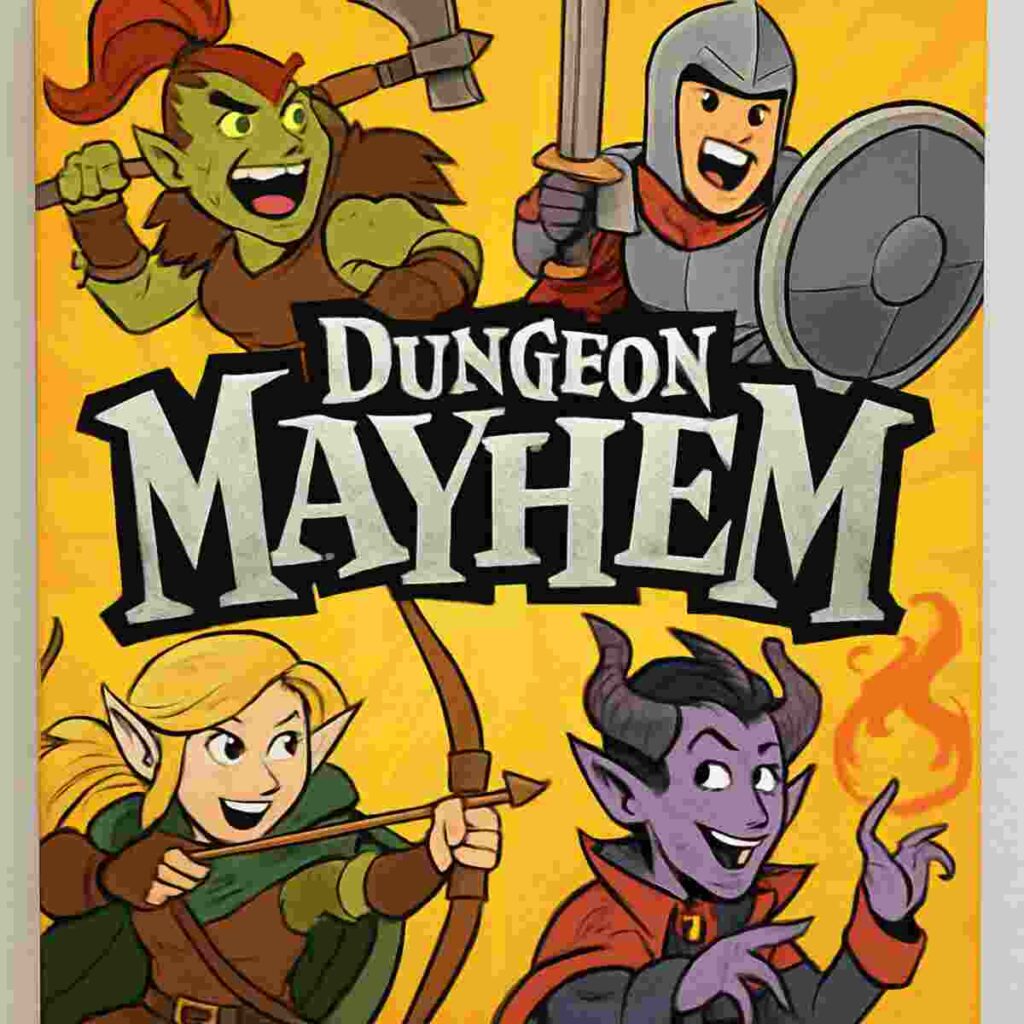
If the idea of a fast-paced fantasy battle sounds perfect for your next game night, your first stop should absolutely be Dungeon Mayhem. This game is a bestseller for a reason: it’s designed to be incredibly easy to learn, stripping away complex rules to get you right to the action in less than five minutes. It’s the perfect, chaotic introduction to slinging spells and swinging swords at your friends.
The goal is wonderfully simple: be the last hero standing. Each player picks a colorful character—like Sutha the Skullcrusher (a Barbarian) or Azzan the Mystic (a Wizard)—and gets their unique deck of cards and 10 Hit Points (HP). On your turn, you just draw one card and play one card. That’s it. You might play a card to zap an opponent and lower their HP, or you might put up a shield to defend yourself. It’s a hilarious, free-for-all fight to knock everyone else out of the game.
Because a full game is usually over in just 15 or 20 minutes, it’s one of the best quick tabletop games for D&D fans and newcomers alike. You can easily play a few rounds in a single evening, making it ideal for families or groups with short attention spans.
How to Play Dungeon Mayhem in 5 Minutes or Less
Your turn in Dungeon Mayhem boils down to two simple actions: draw one card from your deck, then play one card from your hand. That’s the entire turn. You just read the card you played, do what it says, and the action passes to the next player. This rapid pace is a core part of its charm and makes it a fantastic example of simple D&D-inspired card game rules in action.
The key to victory lies in managing your Hit Points (HP). Think of HP exactly like a health bar in a video game. Every player starts with 10, and when a card deals “damage” to you, you subtract that number from your total. The moment your HP hits zero, you’re knocked out for the round. Your goal is to use your cards to chip away at everyone else’s HP while protecting your own.
So, what does playing a card actually look like? Imagine you’re playing as Sutha the Barbarian and you play a card called “Whirling Axes.” The card’s text tells you to “Deal 1 Damage to EVERY other player.” You’d announce your action, and every other player at the table would have to lower their HP total by one. It’s that immediate and interactive.
Of course, not every card is a straightforward attack. You’ll find yourself playing mighty shields to block incoming damage, chugging healing potions to restore your own HP, or using clever tricks to draw extra cards. Each character’s deck is packed with a unique personality and playstyle, making every game a little different.
Who Will You Be? Meeting the Four Heroes of Dungeon Mayhem
Picking your character in Dungeon Mayhem is less about complex strategy and more about choosing how you want to cause trouble. Each of the four starting heroes has its own deck that perfectly matches a classic fantasy personality. This is one of the best parts of any Dungeons and Dragons characters in card games; you’re not just playing cards, you’re adopting a role. The decks are pre-built and balanced, so the only question is: which playstyle sounds the most fun to you?
If you enjoy being the straightforward powerhouse, you’ll love Sutha the Barbarian. Her deck is packed with big, simple attacks that deal heavy damage. On the other side of the coin is Lia, the Paladin, the ultimate defender. Her deck is full of shields to block incoming hits and healing spells to keep her in the fight long after others have fallen. These two provide a classic “unstoppable force meets immovable object” dynamic.
For those who prefer a bit of cunning over brute force, there’s Azzan the Wizard and Oriax the Rogue. Azzan’s deck isn’t about raw power but about bending the rules of the game, letting you draw tons of extra cards or zap opponents with clever spells. Meanwhile, the Rogue is all about speed and misdirection. Her deck lets you play extra turns, steal cards from other players’ hands, and even become “hidden” to avoid attacks entirely.
This built-in variety is what makes a simple game so replayable. Will you be the one smashing through everyone’s health, the unkillable protector, the master of magical mischief, or the sneaky trickster? Because all four are simple to pilot, the game remains incredibly easy to learn, no matter who you choose.
Is Dungeon Mayhem a Good Fit for Your Family Game Night?
If your group enjoys the lighthearted chaos of Uno or the silly tension of Exploding Kittens, Dungeon Mayhem will feel right at home. The game is fast, direct, and encourages a bit of playful rivalry. You’re not just managing your own cards; you’re actively throwing cartoonish fireballs and swinging foam swords at your friends and family to be the last hero standing.
This style of play is often called a “take that” mechanic. Think of how it feels to play a “Draw 4” card in Uno—you’re directly affecting another player. Dungeon Mayhem is full of those moments, but the silly art and over-the-top card effects keep the mood fun and breezy. While some games can feel a bit mean-spirited (a common point in the Dungeon Mayhem vs Munchkin debate), this one is designed to create laughter, making it one of the most cheerful family friendly fantasy card games available.
Designed for 2 to 4 players (ages 8 and up), it’s one of those ideal quick tabletop games that fills a 15-minute gap perfectly. Here’s a quick gut-check:
- Good for fans of: Uno, Exploding Kittens, King of Tokyo.
- Might not be for: Players who dislike any form of direct conflict in games.
Expanding the Mayhem: Which Dungeon Mayhem Expansion Should You Get?
Once you’ve mastered the four original heroes, you might wonder what’s next. Dungeon Mayhem expansions are the perfect answer, and they mostly do one simple thing: add more delightful weirdos to the fight. Each new character comes with a unique deck and playstyle, from a kleptomaniac unicorn to a… well, a gelatinous cube. It’s a fantastic way to inject fresh chaos into your game nights without piling on complicated new rules.
The Monster Madness set changes the game entirely. This bigger box not only gives you six new heroes to play, but it also introduces powerful monsters like a Mind Flayer and a Beholder. Suddenly, you have a choice: you can still fight each other, or you can team up to take on one of these big bosses in a brand-new game mode.
This cooperative option transforms the experience from the ground up. Instead of a “take-that” free-for-all where you’re trying to be the last one standing, you’re now working together, combining card effects to defeat a common enemy. It turns the game from a hilarious player-versus-player battle into a true fantasy adventure card game where teamwork is key, making it one of the best cooperative fantasy card games for a quick, fun session.
If you just want more character variety for the classic brawl, any of the smaller packs will do. But if the idea of teaming up for a shared victory sounds more appealing, Monster Madness is essential. The base game’s competitive nature, however, is a core part of its DNA, drawing frequent comparisons to another legendary “take-that” game: Munchkin.
Dungeon Mayhem vs. Munchkin: Which “Take-That” Game Is for You?
That comparison to Munchkin is a common one, and for good reason. Both games are built on the silly, chaotic fun of playing a fantasy hero, fighting monsters, and gleefully sabotaging your friends to get ahead. They are the kinds of games where you might steal someone’s treasure one minute and help them fight a dragon the next—only to betray them again.
However, the feel and flow of each game are dramatically different. The choice between Dungeon Mayhem vs Munchkin really comes down to how much time and mental energy your group wants to invest in their backstabbing. The core differences are easy to see at a glance:
- Game Time: Dungeon Mayhem is a lightning-fast brawl, usually over in 15 minutes. A game of Munchkin often takes 60-120 minutes.
- Complexity: Dungeon Mayhem is incredibly simple—draw a card, play a card. Munchkin involves more moving parts with levels, gear, and temporary alliances.
- Tone: Dungeon Mayhem is a quick, forgettable laugh. Munchkin is a longer game of building power, holding grudges, and ganging up on the leader.
If you’re looking for one of the best quick tabletop games that you can teach in two minutes and play several times in a night, Dungeon Mayhem is your champion. It’s one of the most accessible family-friendly fantasy card games available. But if fighting your friends isn’t what you’re looking for, it might be time to explore the world of cooperative deck-building.
Ready for a Bigger Quest? An Introduction to Cooperative Deck-Building
While sabotage and backstabbing can be a blast, sometimes you want to feel like a real adventuring party. This is where the best cooperative fantasy card games shine. Instead of fighting each other, everyone at the table forms a single team, working together to overcome challenges presented by the game itself. You win or lose as a group, making victory a shared celebration rather than a solo accomplishment.
Many of these team-based games use a clever mechanic called “deck-building.” The idea is simple: you start the game with a small deck of basic, weaker cards—think a rusty sword and flimsy leather armor. As you defeat monsters and complete quests, you earn the ability to add more powerful cards to your personal deck. Your character literally gets stronger as the game goes on.
A perfect example of this is the Dragonfire deck building game. In Dragonfire, each player chooses a classic D&D character like a Cleric or Wizard and faces a series of monster attacks drawn from a central deck. To survive, you must use your starting cards to acquire better spells and gear, customizing your deck on the fly to support your teammates. It’s one of the most popular deck building games like Dungeons and Dragons because it truly feels like a shared quest unfolding right on your table.
But what if you’re already an expert at slinging spells and summoning creatures? For veterans of games like Magic: The Gathering, the D&D universe offers a different, but equally compelling, strategic experience.
What if You Already Play Magic: The Gathering?
For seasoned Magic: The Gathering players, the leap into a different fantasy card game might feel like learning a whole new language. But what if you could explore the dungeons of Faerûn using the rules you already know and love? The creators of both games had the same idea, leading to one of the most exciting crossovers in tabletop history.
The worlds of Dungeons & Dragons officially collided with the release of Adventures in the Forgotten Realms. This expansion is pure Magic, but every card is dripping with D&D flavor. You’ll find legendary creatures like Drizzt Do’Urden, iconic monsters like Beholders, and spells that feel right at home in any wizard’s spellbook. It’s a full-fledged, Forgotten Realms themed card game built on the foundation you’ve already mastered.
Building on that success, Commander Legends: Battle for Baldur’s Gate focused on the multiplayer Commander format, perfect for capturing the feel of a D&D party. These Magic: The Gathering D&D crossover sets are some of the best deck building games like Dungeons and Dragons for those who already speak the language of lands and mana.
For the Poker Player: What Is Three-Dragon Ante?
If you love the betting, bluffing, and risk-reward of Poker but wish it had more, well, dragons, then Three-Dragon Ante is the game you’re looking for. The Three-Dragon Ante: Legendary Edition packages this classic game of fantasy finance into a single, easy-to-learn box. It’s less about slaying monsters and more about taking your friends’ treasure.
Unlike a single hand of Poker, the game unfolds in rounds where each player contributes three cards to a “flight.” You play one card at a time, comparing its strength to what others have played, with the strongest three-card flight winning the ante. These simple, D&D inspired card game rules create a fast-paced rhythm of betting and revealing, making it one of the best quick tabletop games for D&D fans who enjoy a bit of friendly competition.
The real magic, however, comes from the cards themselves. Each card has a special power that triggers when you play it. A mighty Blue Dragon might force your opponents to pay you gold directly, while a crafty Thief card could steal another player’s strongest card. This adds a layer of chaotic fun and strategy, as the best hand doesn’t always win if another player’s card ability snatches victory away at the last second.
Your Final Choice: Which D&D Card Game Is Right for You?
Where Dungeons & Dragons once seemed like an intimidating world of thick rulebooks, it can now be the star of your next game night. You’re no longer guessing—you’re ready to match the right adventure to your group. To find the best D&D card game for your table, use this simple guide:
- Dungeon Mayhem: The fastest, funniest, and easiest brawler for any group.
- Dungeon Mayhem: Monster Madness: To work together as a team in a simple cooperative mode.
- Dragonfire: A deep, cooperative challenge for a longer adventure.
- Three-Dragon Ante: A fantasy version of Poker with betting and bluffing.
- Magic: The Gathering Crossovers: To add D&D flavor to a game you already love.
Whichever you choose, you’re not just playing cards—you’re opening a door to a new kind of adventure, one hero and one laugh at a time.